Ranked
The Cheapest Card Machine in South Africa (2026)
Cheapest to buy, cheapest to use and cheapest to own are three different machines. Which one you need depends on how your shop runs. Checked August 2026.

Some links here are referral links, and where a provider gives our readers a better price than its own site, that is the price you get by using one. It costs you nothing extra, and every option here is judged on the same test either way.
There is a man who sells boerewors rolls outside a hardware shop in Springs, and for two years he has been turning away anyone without cash because a card machine felt like something you buy once the business is bigger.
He was wrong about that, and probably so are you. Right now, the cheapest way to take a card payment in this country costs nothing at all, and the second cheapest costs R200.
But "cheapest" is doing a lot of work in that sentence, and it is the reason most articles on this subject are not that helpful. Cheapest to buy, cheapest per sale, and cheapest to still be running in a year are three different machines. So tell me which cheap you mean and I will tell you which one to get.
The one that is actually free
iKhokha gives away a card machine, and almost nobody writing about cheap card machines mentions it.
iK Tap on Phone is free. You download the iKhokha app on an Android or Huawei phone, and the phone becomes the card machine. A customer taps their card or their watch against the back of it and the money is yours. There is no hardware to buy, no rental, no monthly fee, and no setup cost.
For the boerewors stall, for a hairdresser who works from home, for anyone testing whether card payments are worth the fuss at all, this is the correct answer and it costs you nothing to find out.
Now the catches, because there are three and they are all real.
It is Android only. If your phone is an iPhone, Yoco's Tap to Pay does the same job on iOS, so the free route still exists, it just belongs to the other company.
Your phone is the card machine, which means your battery and your signal are now your payment system. And there is no printed slip and no prepaid menu, so a counter that needs receipts or wants to sell airtime has already outgrown it.
None of that makes it a toy. It makes it the cheapest sensible starting point in this market.
iKhokha iK Tap on Phone
Who it's for
The cheapest honest way to start: the app turns an Android handset into the machine, and a customer taps the back of the phone. Right for a stall, a home salon, or anyone still finding out whether card payments are worth the fuss.
- What it costsNothing to get. The transaction fee is iKhokha's usual rate
- What you give upAndroid only, no printed slip, and your battery and signal are now the payment system
What iKhokha gives everyone
- Unlimited digital invoices, free, from the iK Invoice tool
- Same-day payouts, twice a day, on Nedbank or the iK Debit Card for sole traders, at R2.50 each
Checked 24 Sep 2026
Cheapest to get started: WAPPoint, at R200
If you want a real machine on the counter and R699 is the thing standing in your way, WAPPoint is the answer and it is not close.
You pay R200 to set up and then a monthly rental, and the rental disappears entirely in any month you clear a turnover threshold. On the entry machine that threshold is R15 000 a month. Clear it and the machine costs you nothing but the R50 insurance.
There is a second thing worth knowing. WAPPoint is usually described as rental-only, and it is not. You can rent it, get it free on turnover, or buy it outright. It simply does not publish a purchase price, so you have to ask for it.
The catch is the one the low entry price hides. WAPPoint starts at 2.75% Excluding VATThe rate before 15% VAT is added, which is how almost every South African provider quotes. A rate of 2.30% excl. VAT actually bills you 2.645%, so two quotes are only comparable once you know which basis each is on.What the cheapest rate really billsYoco's 2.30% bills 2.645%. On R20 000 a month that is R529 rather than R460, so about R828 a year sits between the rate you compare and the rate you pay.Every card machine rate in South Africa is quoted excluding VAT, which is convenient: it means the providers in this guide are directly comparable to each other with no conversion at all. It stops being safe the moment you compare one of them to a bank, because some banks quote including VAT and the same rate then looks cheaper on one page than on another. If your business is VAT-registered you claim it back and the excluding number is your real cost. If it is not, and most small counters are not, add 15% to everything here.See every term in the glossary, the same as iKhokha and above Yoco's 2.30%. Below the turnover threshold you are paying R189 rental plus R50 insurance every month, which is R2 868 a year for a machine you could have bought once for R699.
So this is the cheapest way in and one of the more expensive ways to stay, which our WAPPoint review prices out threshold by threshold. Which is fine, as long as it is a decision rather than a surprise.
WAPPoint SquarePOS RX

Accepts
- Tap only
- Visa
- Mastercard
- SASSA
- Apple Pay
- Google Pay
- Snap & Pay QR
From wappoint.co.za, checked 24 Sep 2026
Who it's for
For a business that is trading properly and cannot put R699 down this month. You pay to set up rather than to buy, and the rental disappears in any month you clear the threshold.
- RentalR189 a month, waived in any month you turn over more than R15 000
- Transaction feeFrom 2.75% excluding VAT — the more expensive way to stay
What Wappoint POS gives everyone
- The rental falls away in any month you clear the machine's threshold: R15 000 on SquarePOS RX, R25 000 on MiniPOS, R45 000 on PrintPOS
- Switch to a different machine as the business changes
Checked 24 Sep 2026
Cheapest per sale, and cheapest to own: the Yoco Khumo 2
This is the one most people should buy, and the reasoning is boring in the best way.
R699 once, down from R1 299. Nothing monthly on Yoco's Core plan. 2.30% excluding VAT on local cards, the lowest fee you can get without switching banks, and it drops to 1.35% on local debit once you pass R50 000 a month. The mobile data is included for life, and Yoco charges nothing at all to pay you.
There is no settlement fee, no monthly minimum and no contract, so a month where you take nothing costs you nothing.
Yoco sells paid plans too, and this is where "cheapest" gets tested. Core (Yoco's plan)Yoco's standard plan, and the one almost every small business is on. It costs R0 a month, charges 2.30% excluding VAT per local card sale, and includes the dual-SIM mobile data free for life. Instant Payout costs R17.25 for a payout of up to R1 000 and 1% above that, up to R10 000 a day.What the free plan includesR0 a month, the 2.30% rate, the data, the POS app, and access to Yoco Capital. The paid plans buy a lower rate, not a working machine.Core is Yoco's free plan and the one almost every small business is on. Every Yoco figure in this guide is quoted on it. Yoco also sells Plus at R249 a month and Pro at R499 a month, which buy lower rates: Plus takes local debit to 2.10% and Pro to 1.95%, and Pro includes fast payouts at no charge. Those only make sense at volume. On R30 000 a month, R249 of plan fee buys you about R60 of rate saving, so Core stays the cheaper plan until you are turning over a great deal more than that.See every term in the glossary is free. Plus (Yoco's plan)Yoco's middle plan at R249 a month per location. It is the tier that carries appointment management, a built-in loyalty programme and multi-location management, and it lowers the card rate to 2.10% excluding VAT on local debit up to R50,000 a month. Nothing on Core is taken away to make it; Plus adds. The plan above it is Pro at R499 a month, which is the only tier where fast payouts are free.Does the cheaper rate pay for the plan?At R30 000 a month on card, Yoco's Plus plan saves about R60 in fees and costs R249. The plan pays for itself somewhere above R80 000 a month, which is why Core is the cheap answer for most counters.Plus is Yoco's middle plan at R249 a month per location. It lowers the local debit rate to 2.10% excluding VAT up to R50 000 a month and adds appointment management, a loyalty programme and multi-location management. Nothing on Core is removed to make it; Plus adds. Above it sits Pro at R499 a month, which is the only tier where fast payouts are free.See every term in the glossary is R249 a month and takes local debit to 2.10%; Pro is R499 and takes it to 1.95%, with fast payouts thrown in.
Run the arithmetic before anyone talks you up a tier. On R30 000 a month, moving from Yoco's Core plan to its Plus plan saves you about R60 in fee and costs you R249 in plan fee. The free plan is the cheap one until your turnover is several times that, and any salesperson who tells you otherwise is selling the loyalty features, not the price.
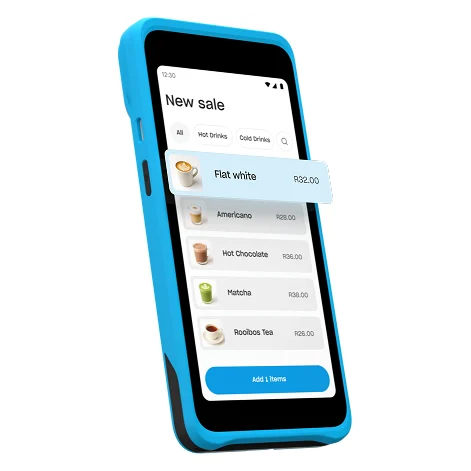
Yoco Khumo 2
Accepts
- Tap, chip & swipe
- Visa
- Mastercard
- Amex
- SASSA
- Apple Pay
- Google Pay
- Samsung Pay
From yoco.com, checked 24 Sep 2026
Who it's for
The one most counters should buy. The lowest published fee you can get without moving banks, nothing monthly, and a month with no sales costs you nothing at all.
- Transaction fee2.30% excluding VAT on local cards, on the free Core plan
- MonthlyR0, with the mobile data included for life
What you get with the extra Yoco discount
- R100 off your card machine, which Yoco takes off when you sign up through our link
And everything Yoco gives everyone
- Sign up in 5 minutes, and it works with the bank account you already have
- Paid out in 1 to 2 business days into that same account
- A 1-year warranty and a 30-day money-back guarantee
Checked 24 Sep 2026
you'll go to www.yoco.com's sign-up page with your extra R100 discount applied
What Yoco works withRead 2 Oct 2026
-
POS software
On any Yoco plan
- LightspeedConnected
- LoyverseConnected
- TallOrderConnected
- SalonBridgeComing soon
-
Accounting
Needs the Plus plan, R249 a month
- XeroConnected
- SageConnected
- QuickBooksConnected
- StubConnected
-
Online store
Yoco's ecommerce plugin
- ShopifyConnected
- WooCommerceConnected
- ShopstarConnected
- WixConnected
What a year actually costs
Sticker price is one payment. The fee is every payment for as long as you are in business, so here is the whole year on a counter turning over R20 000 a month, which is a real small shop rather than a flattering example.
R240 000 of card turnover across the year. Every rate excludes VAT, which is how all three publish, so these are directly comparable.
One year at R20,000 a month
| iK Tap on Phone | Yoco Khumo 2 | WAPPoint SquarePOS RX | |
|---|---|---|---|
| Day one | R0 | R699 | R200 |
| Rate | 2.75% | 2.30% | 2.75% |
| Transaction fees for the year | R6 600 | R5 520 | R6 600 |
| Monthly costs | R0 | R0 |
|
| Cost to be paid | R2.50 a payout | R0 | R0 |
| Year one, all in | About R7,380 | About R6,219 | About R7,400 |
mashjoy.com calculation from each company's own price list. Payout fees assume six trading days a week. WAPPoint shown at its best, above the R15 000 threshold where the rental falls away.← scroll sideways on a narrow screen →
The free machine is not the cheapest machine. Over a year at R20 000 a month the Khumo 2 costs about R1 160 less than the free option and about R1 180 less than the cheapest way in, because a 0.45 point rate difference on R240 000 is worth far more than R699.
Which is the whole argument of this article in one row: the cheapest thing to buy and the cheapest thing to own are not the same object.
The free machine finishes last. Not because it is bad, but because 0.45 of a percentage point on R240 000 of turnover is R1 080, and no amount of free hardware catches that up. The same goes for the R200 way in. Our fees guide explains where that 0.45 of a point actually goes.
Under about R5 000 a month the picture reverses and the free option wins comfortably, because the fee barely matters when the turnover is small. The crossover is roughly where the machine pays for itself in fee savings, and at R20 000 a month you passed it long ago.
Hold that thought: the cheapest machine can cost the most
Everything above assumes two things about you, and if either is wrong the ranking moves.
The first is that you can wait one to two business days for your money. If you buy stock every morning you cannot, and pulling your takings forward costs real money.
Yoco charges R17.25 or 1% for an instant payout on Yoco's Core plan, and iKhokha's no-percentage route is gated to Nedbank customers, or to sole proprietors with a second bank account. For a counter drawing daily, that can outweigh everything in the table above.
The second is that the machine only takes money. If people at your till already ask for airtime, electricity or vouchers, the iK Flyer Lite can sell them all of it and keep a commission, on the same R699 hardware. Where people already buy airtime from you, that income can clear the fee difference, which we work out properly in the iKhokha review.
Where cheap quietly stops being cheap
Four costs sit outside the headline number, and every one of them has turned somebody's bargain into an expensive year. Two of them are about SettlementWhen the money actually lands in your bank account — not when the payment is approved. The gap is one to three business days depending on provider.What it costs on the cheap machinesNothing on Yoco and nothing on WAPPoint. R2.50 a payout on iKhokha, which is about R65 a month if you draw every trading day.Settlement is when the money actually lands in your account, not when the payment is approved on the machine. It is one to two business days across every provider in this guide as standard. It belongs in a cheapest-machine article because it is priced three different ways and none of them appear on a rate card: as a flat fee per payout, as a percentage to jump the queue, or as a set of conditions you either meet or do not.See every term in the glossary, which is the part of a card machine nobody compares and everybody pays for.
The rental below the threshold
WAPPoint's rental only disappears above R15,000 a month on the entry machine. Under it you are paying R189 plus R50 insurance.
R2 868 a year for a machine that costs R699 to own. If your turnover sits just under a threshold, that is the single most expensive line in this article.The monthly SIM
iKhokha's two 4G SIMs are R75 a month and optional. Yoco includes its data for life. On the shop Wi-Fi, iKhokha's is R0.
R900 a year, and it is avoidable in one afternoon by putting the machine on the Wi-Fi you already pay for.The charge to be paid
iKhokha takes R2.50 every time it settles money into your account. Yoco takes nothing. WAPPoint takes nothing.
About R65 a month if you draw every trading day. Small per payout, and it is charged on the amount you are owed rather than on a sale.The price of speed
Standard settlement is one to two business days everywhere here. Getting it sooner is a percentage on Yoco and a set of conditions on iKhokha.
This is the one that catches daily-stock businesses, and it can cost more than the rate difference it was meant to save.There is a fifth that is not a fee at all, and it is the one I would watch hardest.
Adumo publishes no rate anywhere. That is not automatically bad, and a quote on your real turnover genuinely can beat a price list. But you cannot call a machine cheap until somebody has given you the number, so treat "we will quote you" as a step in the process rather than an answer. Ask Adumo for your number here and we follow it up for you.
The same goes for any bank offering a merchant fee that looks lower on paper. It usually arrives attached to a business account with its own monthly fee and minimum balance, which is a cost you would not otherwise be carrying.
So which one is actually cheapest for you
There is no cheapest card machine. There is a cheapest one for the way your shop runs, and by now you know which of the three you are.
Taking under about R5 000 a month, or still finding out whether card payments are worth it: take the free one. iK Tap on Phone on an Android or Huawei handset, or Yoco's Tap to Pay if you are on an iPhone. Neither appears in the ranked field, because that guide prices machines you buy. It costs nothing to try and nothing to abandon.
Cannot put R699 down this month but you are trading properly: WAPPoint at R200 to set up. Watch the threshold, and move once you can afford to own the machine instead. If you are choosing between the two that win on fee, the head-to-head settles it.
Everyone else, which is most people reading this: the Yoco Khumo 2 at R699. Lowest fee without switching banks, nothing monthly, nothing to be paid out, and over a year at R20 000 a month it is about R1 160 cheaper than the free option.
And if your counter fields airtime requests all day, stop reading the rate card. The iK Flyer Lite is the same R699 and it earns money back, which no rate difference in this market can match.
Then answer the three questions below for your own shop: what you take in a month, whether people ask you for airtime, and how soon you need the money.
Interactive · 30 seconds
Which cheap is your cheap?
Answer for how your shop actually runs, and the recommendation updates as you go.
1What do you take on card in a month?
2Do people at your till ask for airtime, electricity or vouchers?
3Can you put R699 down this month?
Before you answer
The Yoco Khumo 2, for most people who ask this question
R699 once, 2.30% excluding VAT, nothing monthly and nothing charged to pay you. Over a year it beats both the free machine and the cheapest way in.
The trade-off: it earns you nothing on airtime, and pulling your money forward early costs a percentage.
Rates and prices come from each company's own website, checked 29 August 2026. We rank on one-year cost, the same way for every brand, which is why the free machine finishes third on this page and is still the right answer for some readers.
Questions people actually ask
Costs
What is the cheapest card machine in South Africa?
iK Tap on Phone is free: it turns an Android or Huawei phone into a card machine at no cost, with no hardware, rental or monthly fee.Yoco's Tap to Pay does the same on iPhone. If you want an actual card machine, WAPPoint is cheapest to start at R200 setup, and the Yoco Khumo 2 is cheapest to own at R699 once with a 2.30% rate excluding VAT. Checked 29 August 2026.
Is there a free card machine in South Africa?
Yes, two of them, and both use a phone rather than hardware.iKhokha's iK Tap on Phone is free on Android or Huawei and Yoco's Tap to Pay is free on iPhone. Neither charges a rental or a monthly fee; you pay only the transaction rate. Neither prints receipts, and your phone becomes the card machine, so its battery and signal become your payment system.
Which card machine has the lowest transaction fee?
Yoco, at 2.30% excluding VAT on local cards on its free Core plan, dropping to 1.35% on local debit between R50,000 and R200,000 a month.iKhokha and WAPPoint both start at 2.75% excluding VAT. Yoco also sells Plus at R249 a month for 2.10% and Pro at R499 for 1.95%, which only pay for themselves at high turnover. Checked 29 August 2026.
Is a cheaper card machine always cheaper?
No. Over a year at R20,000 a month on card, the free iK Tap on Phone costs about R7,380 and the R699 Yoco Khumo 2 costs about R6,219, because a 0.45 percentage point rate difference on R240,000 of turnover is worth more than the hardware.Below roughly R5,000 a month the free option wins, because the rate barely matters at that size.
Getting started
Can I get a card machine with no monthly fee?
Yes. Yoco's Core plan and iKhokha both charge no monthly fee: you buy the machine once and pay only the transaction rate.iKhokha's two 4G SIMs are an optional R75 a month and free if you run the machine on your own Wi-Fi. WAPPoint charges a monthly rental, but waives it in any month you clear its turnover threshold.
Do I need a business bank account for a cheap card machine?
No. Yoco, iKhokha and WAPPoint all onboard sole proprietors and pay into a personal bank account, with no registered company required.A bank's own merchant rate can look lower on paper but usually requires a business account with its own monthly fee and minimum balance, which is a cost you would not otherwise carry.