Comparison
Capitec vs Yoco (2026): Which Card Machine Is Cheaper?
Capitec is cheaper on rate at every tier and card type. Whether that is worth anything comes down to one R50 fee and where you bank. Checked September 2026.

Some links here are referral links, and where a provider gives our readers a better price than its own site, that is the price you get by using one. It costs you nothing extra, and every option here is judged on the same test either way.
I went into this comparison expecting the usual ending, where the bank looks cheap on paper and the fintech wins on everything that matters. The rate card Capitec publishes does not allow it.
Capitec is currently cheaper than Yoco on local debit, on local credit, and on international cards, at every tier either company publishes. There is no turnover at which Yoco's percentage goes under Capitec's. That comes first, because the rest of this only makes sense once it is settled.
What actually decides it follows, and none of it is a percentage: a R50 monthly fee, a rule about who is registered with CIPC, and the question of which bank pays you. Our fees guide covers how to work out what you are really paying now.
Capitec is cheaper on rate, and it is not close
Here are both rate cards next to each other. Capitec's applies to merchants who bank with Capitec, which is the only way it is sold, and Yoco's is Yoco CoreYoco's standard plan, and the one almost every small business is on. It costs R0 a month, charges 2.30% excluding VAT per local card sale, and includes the dual-SIM mobile data free for life. Instant Payout costs R17.25 for a payout of up to R1 000 and 1% above that, up to R10 000 a day.What it costs against CapitecCore is the R0 plan, and its 2.30% is the Yoco figure in every table on this page. Yoco's paid plans do cut the rate, and R249 a month buys 2.10% where Capitec charges 1.85% for nothing.Core is Yoco's entry plan and the one almost every small business is on: no monthly fee, the point-of-sale software included, and card rates that step down with turnover. It matters in a bank comparison because Yoco has two plans above it, Plus at R249 a month and Pro at R499, and those buy lower percentages. A fair comparison against a bank uses Core, because Core is the plan with no subscription on the other side of the scale.See every term in the glossary, which costs nothing a month. Both companies quote Excluding VATThe rate before 15% VAT is added, which is how almost every South African provider quotes. A rate of 2.30% excl. VAT actually bills you 2.645%, so two quotes are only comparable once you know which basis each is on.Why it matters more here than usual1.85% bills you 2.1275% and 2.30% bills you 2.645%. Both companies quote the same way, so this comparison is safe as it stands.Card machine rates in South Africa are quoted excluding VAT, and the money that actually leaves your account is the figure plus 15%. Comparing two providers who both quote this way is straightforward, which is the case on this page. It stops being safe the moment somebody hands you a quote that is VAT-inclusive, because the same real rate then looks cheaper than the one next to it. When you work your own rate off a statement you are working off VAT-inclusive money, so convert it before you compare it to anything here.See every term in the glossary, so nothing needs converting before you read across.
Read the international column too. It is the one people skip, and if you sell to tourists it is the widest gap on the page.
Every figure is quoted excluding VAT, which is how both companies publish, so the comparison is direct.
Both rate cards side by side
| Capitec Pro | Yoco Core | |
|---|---|---|
| Machine | R699 once-off, Print R1 399 | R699 once-off, Khumo Print 2 R1 499 |
| Monthly fee on the machine | R0, no contract | R0, no contract |
| Local debit, to R50 000/mo | 1.85% | 2.30% |
| Local debit, above R50 000/mo | 0.85% | 1.35% |
| Local credit, to R50 000/mo | 1.85% | 2.30% |
| Local credit, above R50 000/mo | 1.85%, then 1.70% above R500 000 | 2.30% |
| International cards | 2.3% at every tier | 3.20%, easing to 2.75% above R50 000 |
| Settlement | Free next day, weekends and public holidays included, into a Capitec account | 1 to 2 business days into any South African bank, free |
| What it takes to get paid | An account at Capitec. A CIPC-registered company must use the business one at R50/mo | The bank account you already have |
Both companies' own rate cards, read 10 September 2026.
Capitec wins every rate row on this table. Yoco wins the row underneath them.
That last row is not a consolation prize. It is the whole comparison, and the next section prices it.
A table this one-sided should make you suspicious, so here are the two things it does not show.
Capitec's step down to 0.85% is on local debit only. Credit cards stay at 1.85% until you are turning over half a million a month, so a business whose customers mostly tap credit never sees the dramatic number. And the tiers do not move the day you cross them: Capitec adjusts after three consecutive months of increased card sales.
Yoco also sells lower fees than the ones above. Plus (Yoco's plan)Yoco's middle plan at R249 a month per location. It is the tier that carries appointment management, a built-in loyalty programme and multi-location management, and it lowers the card rate to 2.10% excluding VAT on local debit up to R50,000 a month. Nothing on Core is taken away to make it; Plus adds. The plan above it is Pro at R499 a month, which is the only tier where fast payouts are free.Does it catch Capitec?No. Plus buys 2.10% for R249 a month where Capitec charges 1.85% for nothing, so the subscription moves Yoco closer without passing the bank.Plus is Yoco's middle plan at R249 a month per location. It lowers the local debit rate to 2.10% excluding VAT up to R50 000 a month and adds appointment management, a loyalty programme and multi-location management. Nothing on Core is removed to make it; Plus adds. Above it sits Pro at R499 a month, which is the only tier where fast payouts are free.See every term in the glossary at R249 a month and Pro at R499 both cut the percentage. Neither gets under Capitec at the same turnover, and you are paying a subscription for the privilege of not quite catching up.
The R50 that decides it
Capitec settles into a Capitec account. If you are a CIPC-registered company you have to use the business one, and Capitec Business Banking is R50 a month with a R150 minimum balance to keep it open.
That fee is fixed and the fee saving is a percentage, which means there is a turnover below which the better fee does not pay for the account it requires. Here is where it sits.
Local debit card sales in a month, excluding VAT, for a registered company paying the R50 account fee.
What it actually costs a month
| Capitec, plus the R50 account | Yoco Core | |
|---|---|---|
| R5 000 a month | R142.50 | R115.00 |
| R10 000 a month | R235.00 | R230.00 |
| R15 000 a month | R327.50 | R345.00 |
| R30 000 a month | R605.00 | R690.00 |
| R60 000 a month | R560.00 | R810.00 |
| R100 000 a month | R900.00 | R1 350.00 |
mashjoy.com calculation from both companies' rate cards, 10 September 2026. Assumes local debit throughout and that Capitec has already stepped the merchant down a tier.
The line sits at about R11 100 a month. Under it Yoco costs less, over it Capitec does, and the gap keeps opening.
Look at the R60 000 row twice. Capitec charges less there in absolute rands than it does at R40 000, because that is where the debit tier drops.
Two rows on that table go against the brand we are paid by and they are in it because they are true. Under about R11 100 a month the R50 eats the saving and Yoco is simply the cheaper machine.
Over that line it reverses hard. At R30 000 a month Capitec saves roughly R1 020 a year. At R60 000 it is R3 000, because the debit tier has dropped and Yoco's has not dropped as far.
And there is a reader for whom the R50 never applies at all. A sole trader who is not registered with CIPC can take Capitec settlement into a personal Capitec account, which means no business account, no fee, and a cheaper fee at every level with nothing on the other side of the scale.
Hold that thought: the weekend
Yoco's own website runs a comparison headed "Why not just get one from your bank?", and the first advantage it claims over banks is getting your money the same day you make the sale. It is worth checking that one, because this is the axis Yoco chose.
Yoco's free SettlementWhen the money actually lands in your bank account — not when the payment is approved. The gap is one to three business days depending on provider.Where the two differA Saturday sale settles into a Capitec account on Sunday at no charge. The same sale on Yoco's free route is paid out on Tuesday, because weekends are not business days.Settlement is the gap between a customer's card being approved at your counter and that money being available in your bank account. The card is authorised instantly, but the funds move through the acquiring bank on a separate clock, and that clock is what every provider is quoting when it advertises payout speed. Two things decide whether it matters to you: whether you buy stock with the takings, and whether you are open on days the banking system treats as non-business days.See every term in the glossary is 1 to 2 business days. Same-day money is an Instant Payout, which costs R17.25 a payout up to R1 000 and 1% above that on Yoco's Core plan, and is only free if you are paying R499 a month for the Pro plan. Capitec settles free the next day, and its page states that this includes weekends and public holidays.
For a Saturday market trader those are different worlds. Capitec pays out on Sunday at no cost. Yoco's free route waits for Monday to count as a business day and lands Tuesday. On the exact comparison Yoco picked to argue against banks, the bank wins.
- Capitec Sunday, freeweekends and public holidays included
- Yoco Tuesday, freesooner with an Instant Payout, free only on Pro
Same dayDay 1Day 2Day 3
That finding has one limit, and it is where the money lands. Capitec pays into a Capitec account, so a trader who banks at FNB has the cash on Sunday and still has to move it. Yoco pays into whatever account you already use, and for most people that is the account the rent comes out of.
So it is a genuine win for Capitec and a narrow one. It matters enormously if you are open on weekends and already bank there, and almost not at all if you do not.
What it takes to get each one
This is the section the fee table cannot show you, and for most readers it decides the article.
Capitec: an account at Capitec
Settlement goes into a Capitec personal or business account. Only a CIPC-registered company is required to use the business one, at R50 a month with a R150 minimum balance.
This is the real gate, and it is smaller than we used to say. A sole trader who is not registered opens nothing new if they already bank there, and opens a personal account if they do not.Yoco: the bank account you already have
Any South African bank. Sign-up is online, takes about five minutes, and the machine is delivered free within three days or collected the same day from over 300 stores.
Nothing to switch and nothing to close. For a business that already has banking it likes, this is the entire argument, and it is a good one.Both: FICA, and proof you are who you say
ID, and the usual verification. Neither of them can skip this and neither is unusual about it.
It is not a differentiator, though it gets sold as one.Capitec: three months before the rate improves
The step down to 0.85% on debit is applied after three consecutive months of increased card sales, not on the month you cross the threshold.
If you are buying on the strength of the lower tier, budget for the higher one first. The saving is real and it is not immediate.One asymmetry matters here. Capitec is a bank selling a card machine to its own customers, and Yoco is a company whose entire product is not needing to be somebody's customer first.
If you already bank at Capitec, the gate is not there at all and the fee is simply better. If you bank anywhere else, you are being asked to move money through an account you did not want in order to save a percentage, and whether that is worth it is the arithmetic two sections up.
The two machines
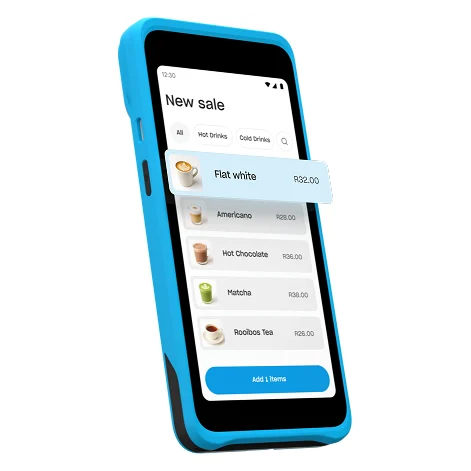
The hardware is closer than the companies are. Both are R699 for the entry model, both run dual SIM with data included, both hold a full trading day on a charge, and both have a printing model a few hundred rands up.
Yoco Khumo 2
Accepts
- Tap, chip & swipe
- Visa
- Mastercard
- Amex
- SASSA
- Apple Pay
- Google Pay
- Samsung Pay
From yoco.com, checked 24 Sep 2026
Who it's for
The one to buy if the account you already have is the account you want paying you. Same R699 as Capitec, a higher rate, and a full till system in the price.
- Monthly Data FeeR0 (on standard Core plan)
- Transaction Fee2.30% (excl. VAT) local cards; 1.35% on debit above R50k/month
- ConnectivityDual SIM 4G & WiFi
- PrinterNone (Digital receipts via SMS/Email)
What you get with the extra Yoco discount
- R100 off your card machine, which Yoco takes off when you sign up through our link
And everything Yoco gives everyone
- Sign up in 5 minutes, and it works with the bank account you already have
- Paid out in 1 to 2 business days into that same account
- A 1-year warranty and a 30-day money-back guarantee
Checked 24 Sep 2026
you'll go to www.yoco.com's sign-up page with your extra R100 discount applied
What Yoco works withRead 2 Oct 2026
-
POS software
On any Yoco plan
- LightspeedConnected
- LoyverseConnected
- TallOrderConnected
- SalonBridgeComing soon
-
Accounting
Needs the Plus plan, R249 a month
- XeroConnected
- SageConnected
- QuickBooksConnected
- StubConnected
-
Online store
Yoco's ecommerce plugin
- ShopifyConnected
- WooCommerceConnected
- ShopstarConnected
- WixConnected
Capitec Pro Device

Accepts
- Tap, chip & swipe
- Visa
- Mastercard
- Amex
- Diners
- RCS
- SASSA
- Apple Pay
- Google Pay
- Samsung Pay
Amex, Diners and RCS need a separate sign-up with them · From capitecbank.co.za, checked 24 Sep 2026
Who it's for
The cheaper card rate on this page at every tier, and free settlement on a Sunday. It pays into a Capitec account and nowhere else, which is the whole trade-off.
- Monthly FeeR0 on the machine
- Transaction Fee1.85% on local debit and credit (excl. VAT), dropping with turnover
- International Cards2.3% (excl. VAT) at every tier
- SettlementFree next day, including weekends and public holidays, into a Capitec account
- ConnectivityDual SIM 4G and WiFi, data included
- PrinterNone, receipts by email
Where they separate is what the machine does when it is not taking a payment. Yoco's till software is included and it is a real product: stock, staff profiles with their own PINs, split bills, partial refunds, tip prompts, and sales on your phone while you are not there.
Capitec's machine tracks sales and prints or emails a receipt. That is the job it was built for and it does it. If the till is also your admin system, that gap is worth more than the fee gap, and if it is a card machine and nothing else, it is worth nothing at all.
The verdict
Both companies made a bet, and both of them are winning it.
Capitec bet that a bank with its own merchant book could undercut the fintechs on price and did not have to be clever about anything else. It has done exactly that. The rate card is lower everywhere, the settlement is genuinely better than what Yoco gives away free, and nothing about the offer is a trick.
Yoco bet that most small businesses would rather start trading on Tuesday than save a percentage, and that the software around the payment is worth more to them than the payment. That is also true, and 169,300 South African businesses is the evidence. Neither of these is a bad product, and neither one loses on its own terms.
So it comes down to which bet describes you.
Take Capitec if you already bank there, or if you are turning over more than about R11 000 a month on card and are willing to. The saving is real, it compounds, and at R60 000 a month it is R3 000 a year for taking the same card.
Take Yoco if you bank somewhere you like, if you are under that line, or if the machine has to run the shop as well as the till. You will pay more per sale and you will keep your banking, your Saturday setup and your existing accountant, and for most of the businesses I write for that side of the business is worth making.
There is no case for both. Two merchant accounts split your turnover across two rate cards and neither one ever reaches the tier your actual takings deserve.
And if your own numbers sit near that line, do not guess at them. Answer the four below and it runs the same arithmetic on your numbers: what you take on card in a month, whether you are registered with CIPC, which bank pays you now, and whether you are open on weekends. It gives back the recommendation this whole comparison was built to reach, with the reasoning rather than just a name.
Interactive · under a minute
Which one is actually cheaper for you?
The same four things that decided this article: what you take on card, whether you are registered with CIPC, who you bank with, and whether you are open on weekends.
1What do you take on card in a month?
2Is the business registered with CIPC?
3Where does your money go now?
4Are you open on weekends?
Before you answer

Use what you actually took last month
The crossover sits at about R11 100 a month and most people guess their card turnover high. It is the one number that changes the answer.
The trade-off: if you are close to the line, the two are within rands of each other and everything else on this page decides it instead.
Both rate cards come from each company's own website, read on 10 September 2026. Capitec is cheaper on rate at every tier and we have no commercial relationship with them, which is why this tool will send you to a bank we are not paid by whenever your numbers say so.
Questions people actually ask
Cost
Is Capitec cheaper than Yoco?
On rate, yes, at every turnover.Capitec charges 1.85% excluding VAT on local debit and credit up to R50 000 a month against Yoco Core's 2.30%, and 0.85% on debit above that against Yoco's 1.35%. Capitec is also cheaper on international cards at 2.3% against 3.20%. The catch is that a CIPC-registered company needs a Capitec business account at R50 a month, which means Yoco works out cheaper overall below roughly R11 100 of monthly card sales. Both rate cards checked 10 September 2026.
Does Yoco ever become cheaper than Capitec as I grow?
No. Yoco's local debit rate drops to 1.35% above R50 000 a month, but Capitec's drops to 0.85% over the same threshold, and continues to 0.70% above R500 000 and 0.60% above R1 million.Yoco's paid plans lower its rates further, at R249 or R499 a month, and still do not go under Capitec at the same turnover. Yoco's advantage over Capitec is access, settlement into any bank and the included point-of-sale software, not price per sale.
Requirements
Do I need a Capitec business account to use their card machine?
Only if your business is registered with CIPC.Capitec's own page says settlement can go into either a Capitec personal or a Capitec business banking account, and that a CIPC-registered merchant must use the business one. That account is R50 a month with a R150 minimum balance. A sole trader trading in their own name can settle into a personal Capitec account. What you cannot do is have Capitec pay you at another bank. Yoco settles into any South African bank account.
Can I use a Capitec card machine if I bank somewhere else?
Not for settlement. The Capitec merchant machine pays into a Capitec account, so banking elsewhere means opening one and moving the money across yourself.That is the practical reason many small businesses pick a fintech even when the bank rate is lower. Yoco, iKhokha and WAPPoint all settle into whatever South African bank account you already use, with no new account and nothing to close.
Payouts
Which pays out faster, Capitec or Yoco?
Capitec, on the free route.Capitec settles free the next day and states that this includes weekends and public holidays, so a Saturday sale is in the account on Sunday. Yoco's free settlement is 1 to 2 business days, so the same Saturday sale arrives Tuesday. Yoco offers same-day Instant Payouts, but they cost R17.25 a payout up to R1 000 and 1% above that on the Core plan, and are only free on Pro at R499 a month. The difference matters most to weekend traders.