Business guide
Best Card Machine for a Spaza Shop (2026)
Which card machine actually suits a spaza shop, why convenience beats a lower transaction fee on this counter, and what each one costs you a month.

Some links here are referral links, and where a provider gives our readers a better price than its own site, that is the price you get by using one. It costs you nothing extra, and every option here is judged on the same test either way.
The basket is R30 and there are six people behind him. That, not the price of the machine, is what decides this.
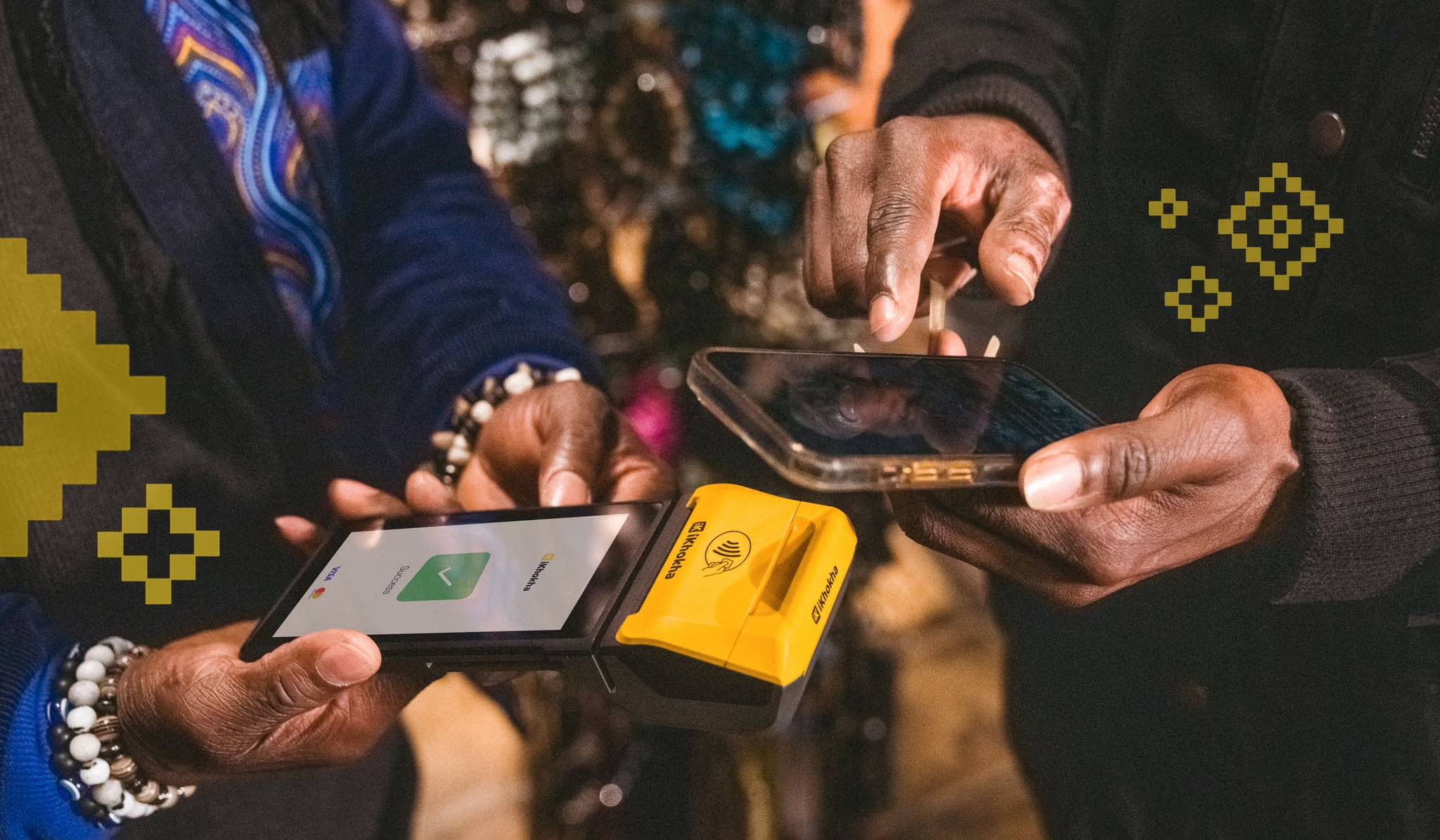
Commissioned · not yet shotMost of the time in a spaza shop, your customers are spending R10, R20, maybe R60 or a bit more. And how they spend at your shop is mostly set by what you have taught them to expect. They buy a loaf and a cold drink, and then they ask you for airtime or electricity, and they ask whether you take cards so they do not always have to walk around with money on them.
Now when it comes to the card machine question, the answer you give becomes the identity of your shop. Meaning, if you did not take cards the day they asked, then yours is the shop that does not take cards, and next time they go to the one that does. Same with airtime or vouchers. You do not lose the sale you said no to, you lose the ones after it.
So if you are reading this because you are thinking about getting a card machine, keep going.
I will help you work out which one is actually right for you between the iKhokha iK Flyer Lite and the Yoco Khumo 2, which are the two cheapest right now, and I will cover the printing versions and the rest of the options as we go.
Which card machine clears the bar for a spaza
A spaza is one of those businesses that survives on convenience. So the decision to add a card machine should come down to one thing: does it add another layer of convenience for the people you want walking in.
If your customers are constantly asking you for airtime, data, electricity or vouchers, you should only be looking at an iKhokha machine to start with.
Yoco charges a slightly lower transaction fee and I will get to that. But convenience is what you actually want on this counter, and if it costs slightly more, that is worth swallowing. More people through the door means more baskets, and an extra R75 a month stops mattering the moment that happens.
It works out because iKhokha dropped the iK Flyer Lite from R999 to R699, and there is a further 10% off through our link, which brings it to about R629.
That puts it at or under the price of a Yoco machine, and Yoco cannot sell airtime for you at all. Yoco's convenience is about something else, which I will show you in a minute.
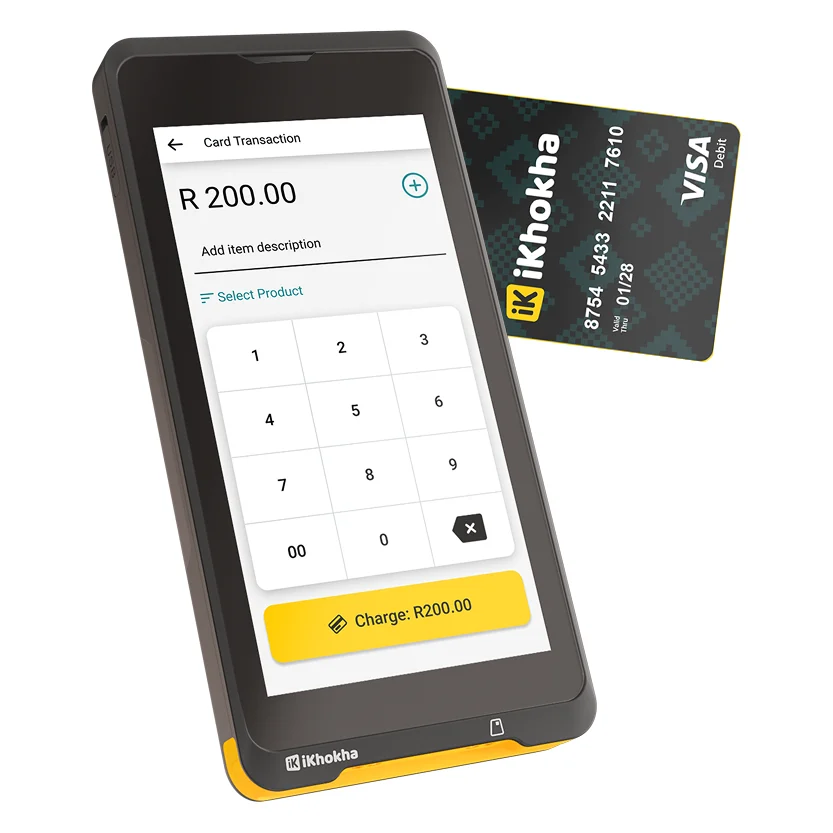
iKhokha iK Flyer Lite
Sells airtime, data, electricity, DStv and vouchers from the same card machine, on commission. That is the reason people stop at your shop rather than the one down the road.
One thing to know before you start: you fund the prepaid float yourself, and the profit on those sales comes back to you the following month. It is real income, it is just not instant income.
iKhokha also does not publish what the commission rate is, so I am not going to make one up. If you already sell airtime by hand, you know what that side of the business is worth on your volumes better than any number I could print here.
So where does Yoco fit in?
Yoco's whole thing is that it charges less per sale and it does not nickel-and-dime you around the money.
It takes 2.30% Excluding VATThe rate before 15% VAT is added, which is how almost every South African provider quotes. A rate of 2.30% excl. VAT actually bills you 2.645%, so two quotes are only comparable once you know which basis each is on.What it costs a spaza counter2.30% bills 2.645%. On R20 000 of card sales a month that is R529 rather than R460, so about R828 a year sits between the rate you read and the rate you pay.Every provider in this guide quotes excluding VAT, so comparing them to each other needs no conversion. Most spaza shops are not VAT-registered, which means you do not claim it back and the inclusive number is your real cost. Add 15% to every rate on this page and you have what actually leaves the till.See every term in the glossary where iKhokha starts at 2.75%. The dual-SIM data is included free for life, so a quiet month costs you nothing, and it charges nothing to pay you out. iKhokha takes R2.50 every time it settles money into your bank account.
If you are the kind of shop where nobody has ever asked for airtime, that is your machine, and you should not pay a higher transaction fee for an engine you are never going to switch on.
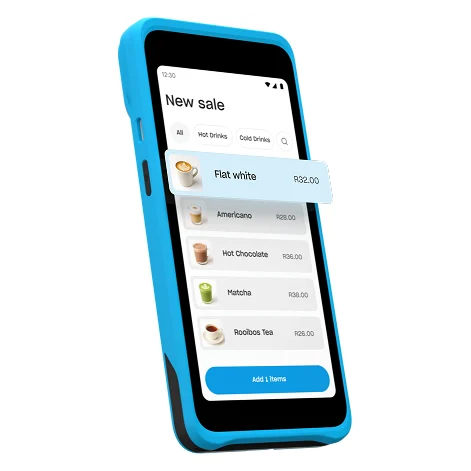
Yoco Khumo 2
Cheaper on every basket at 2.30% excluding VAT, nothing monthly on the free Core plan, dual-SIM data free for life, and it takes nothing to pay you.
Now if Yoco is looking attractive but you still want to sell airtime, there is a way to have both and it costs you nothing extra.
Buy the Yoco Khumo 2 for the card side, then sign up with iKhokha as well and sell prepaid from the free iKhokha App on your phone. The app costs nothing. You are not buying two machines, you are using a free app to fill the prepaid gap.
What the gap actually costs you a month
Say you have settled on one of those two but you want to see what the fees really do on your kind of turnover. For those of you who need the actual numbers, here they are on two shops: a quiet one taking about R5 000 a month on card payments, and one that is doing well at around R25 000 on card payments.
Both machines already bought. Rates exclude VAT. iKhokha payout fees assume a payout on each trading day.
A month on card, at two turnovers
| iKhokha iK Flyer Lite | Yoco Khumo 2 | |
|---|---|---|
| At R5 000/mo | R203 all in | R115 all in |
| You save with Yoco | None | R88 a month |
| At R25 000/mo | R752 all in | R575 all in |
| You save with Yoco | None | R177 a month |
| Sells prepaid for commission | Airtime, electricity, vouchers | No |
mashjoy.com calculation from each company's own price list. iKhokha shown on shop Wi-Fi; add R75 if you take the two SIMs.
So Yoco saves you about R88 a month on a quiet shop and about R177 on a busy one, before you take the SIMs into account.
You can already see which one is cheaper, so the test that matters is whether you are willing to give up selling airtime and electricity in order to keep that R88 or R177 a month.
And that depends on how you think about your shop. If that money covers something real for you this month, then take Yoco and do not feel bad about it.
But look at it the other way round. That R177 is the cost of getting people to stop at your door instead of walking to the shop that does sell airtime. Put like that it is not a loss, it is the cheapest marketing you will ever buy, and it comes back every time somebody walks in for a R12 voucher and leaves with bread as well.
That is the decision, and for a shop taking over about R10 000 a month I do not think it is close. What the extra traffic brings in is bigger than R177. Go with the iKhokha iK Flyer Lite.
If you want to put your own turnover into it rather than take my two examples, our team built a slider that runs on both companies' current fees, so you do not have to keep checking two fee pages that keep changing. Drag it to what your shop actually takes.
-
 Yoco2.30% + R0/moWhere it wins: the lowest rate, with nothing monthly and the data included
R345
Yoco2.30% + R0/moWhere it wins: the lowest rate, with nothing monthly and the data included
R345
-
 iKhokha2.75% + R140/mo with SIMs and payoutsWhere it wins: same-day money with no percentage, and commission on prepaid
R552
iKhokha2.75% + R140/mo with SIMs and payoutsWhere it wins: same-day money with no percentage, and commission on prepaid
R552
becomes the cheaper one above about a month. The answer changes with how you trade, not with who is paying us.
Why one name stays on top: With the box unticked, Yoco is cheaper at every turnover on this slider: 2.30% excluding VAT with nothing monthly, against 2.75% plus R75 for the SIMs and R2.50 a daily payout. Tick it if you buy stock with today's takings, because that is where iKhokha wins. Read at yoco.com and ikhokha.com on 24 September 2026.
Each company's headline rate for local cards from its own price list, excluding VAT, plus the fixed monthly each one bills. iKhokha's R75 dual-SIM add-on is included, and it is R0 if you run the machine on shop Wi-Fi. So is its R2.50 daily payout, about R65 a month. Its tiers step down above R40 000 a month, beyond most spaza turnovers, so they are not modelled. Yoco is R0 monthly on the free Core plan. Payout fees are not in the slider: iKhokha takes R2.50 each time it pays you, so add about R65 a month if you take a payout every trading day.
Yoco costs you R208 less a month here
That is R2,490 over a year at this turnover, before either provider negotiates.
If your shop does not look like either of those
Not every spaza is in the same position, and a few of these come up often enough to be worth answering directly.
Four situations, and what I would do
So what should you buy?
If people already ask you for airtime, data or electricity and you have been sending them across the road, buy the iKhokha iK Flyer Lite. R699, or about R629 through our link, and the counter starts earning on demand that is already walking past you.
If nobody asks, buy the Yoco Khumo 2. A lower fee on every sale, free data for life, nothing taken when it pays you.
And if your customers want a printed slip, neither of those two will do it. Both are digital-receipt only.
What you want is the printing version of whichever one you just picked, because they are the same machines with a thermal printer bolted on.
Both printing versions are R1 499, and I would only spend the extra if people genuinely ask you for slips, since the printer is the whole difference. Here they are side by side.
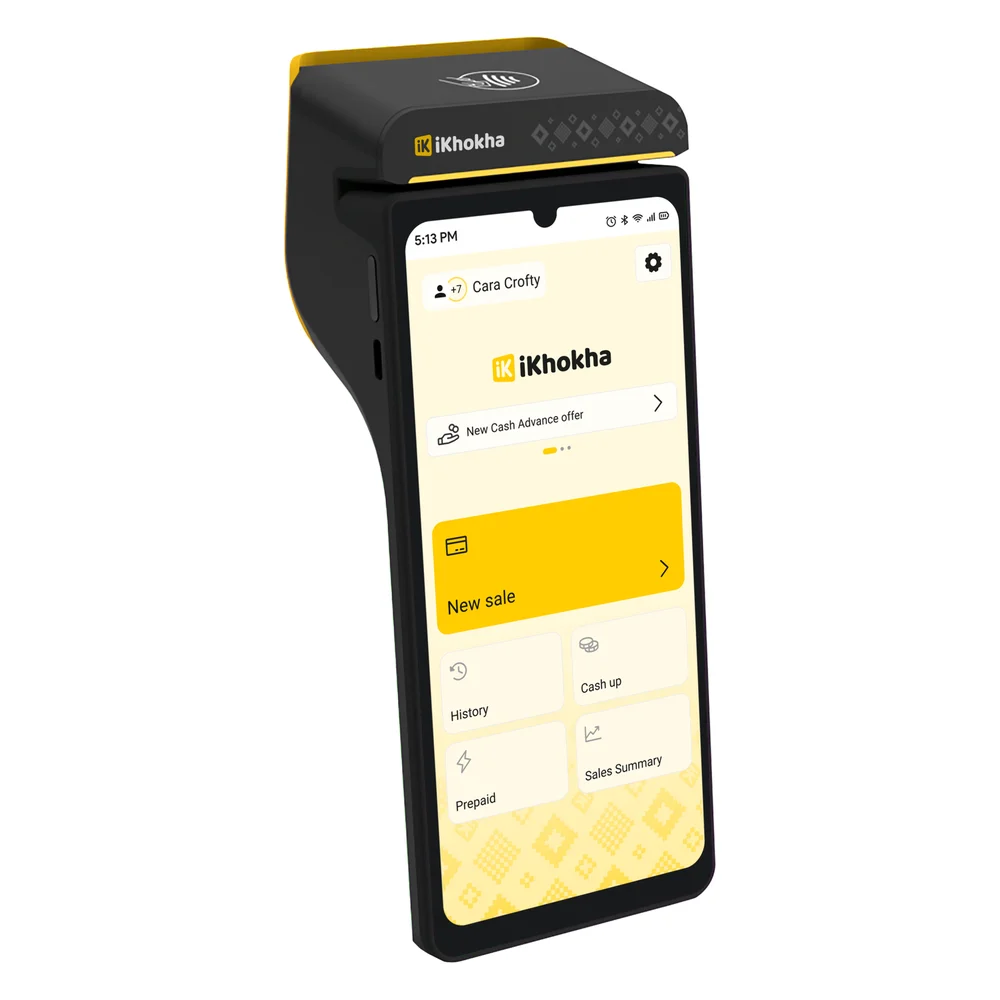
Prints the vouchers too
iKhokha iK Flyer
The iK Flyer Lite with a printer. Still sells airtime and vouchers, and it prints those too.
may earn a commission at no cost to you.
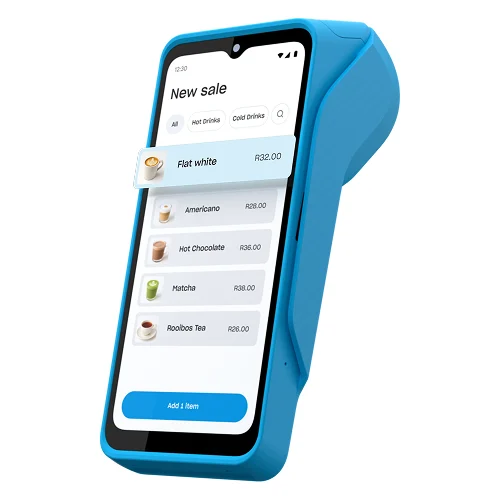
Keeps the free data
Yoco Khumo Print 2
The Khumo 2 with a printer, and it keeps the free data for life.
may earn a commission at no cost to you.
Same rates, same accounts, same everything else as the R699 versions. You are buying the printer.
Checked 11 Sep 2026
And whichever you pick, take your payouts less often than daily if you are on iKhokha. R2.50 a time adds up on small amounts, and it is the one saving on this page that costs you nothing.
If you want to go deeper on the two companies rather than just this counter, I did the full comparison on Yoco vs iKhokha, and the fees guide explains what you are actually paying for on every sale.
Questions people ask me about this
Getting started
Do I need a registered company to get a card machine for my spaza?
No.Both the iKhokha iK Flyer Lite and the Yoco Khumo 2 will onboard a sole proprietor and pay into a personal bank account, so an unregistered one-person shop can take cards.
Day to day
Which card machine lets a spaza shop sell airtime and electricity?
iKhokha, through iK Prepaid, on both the iK Flyer Lite and the iK Flyer.It sells airtime and data on all four networks, electricity, water and gas, DStv and bill payments, traffic fines, and gaming vouchers including Hollywood Bets and OTT. iKhokha pays a commission on those sales but does not publish the rate. Yoco does not offer prepaid at all.
What happens to my card machine during load shedding?
Both machines run on their own battery and their own mobile data, so they keep working when the power and the router go down.Yoco includes that data free for life on Core; iKhokha's two 4G SIMs are R75 a month, or you can run it on shop Wi-Fi for free and accept that it stops when the router does.
Costs & fees
Are card machine fees worth it on small baskets?
A percentage fee scales with the basket, so 2.30% on a R30 sale is 69c and does not punish a small ticket.What hurts a small shop is a flat charge: iKhokha takes R2.50 on every payout regardless of size, so taking payouts less often reduces it. Avoid monthly rentals if your type of business is seasonal.