Business guide
The Best Card Machine for a Market Stall in SA (2026)
A stall has no plug, no Wi-Fi and one shot at a Saturday. What a market trader needs from a machine, measured against five requirements, and which clears them.

Some links here are referral links, and where a provider gives our readers a better price than its own site, that is the price you get by using one. It costs you nothing extra, and every option here is judged on the same test either way.
A stall has no plug and no Wi-Fi, which is why battery and signal decide this before price does.
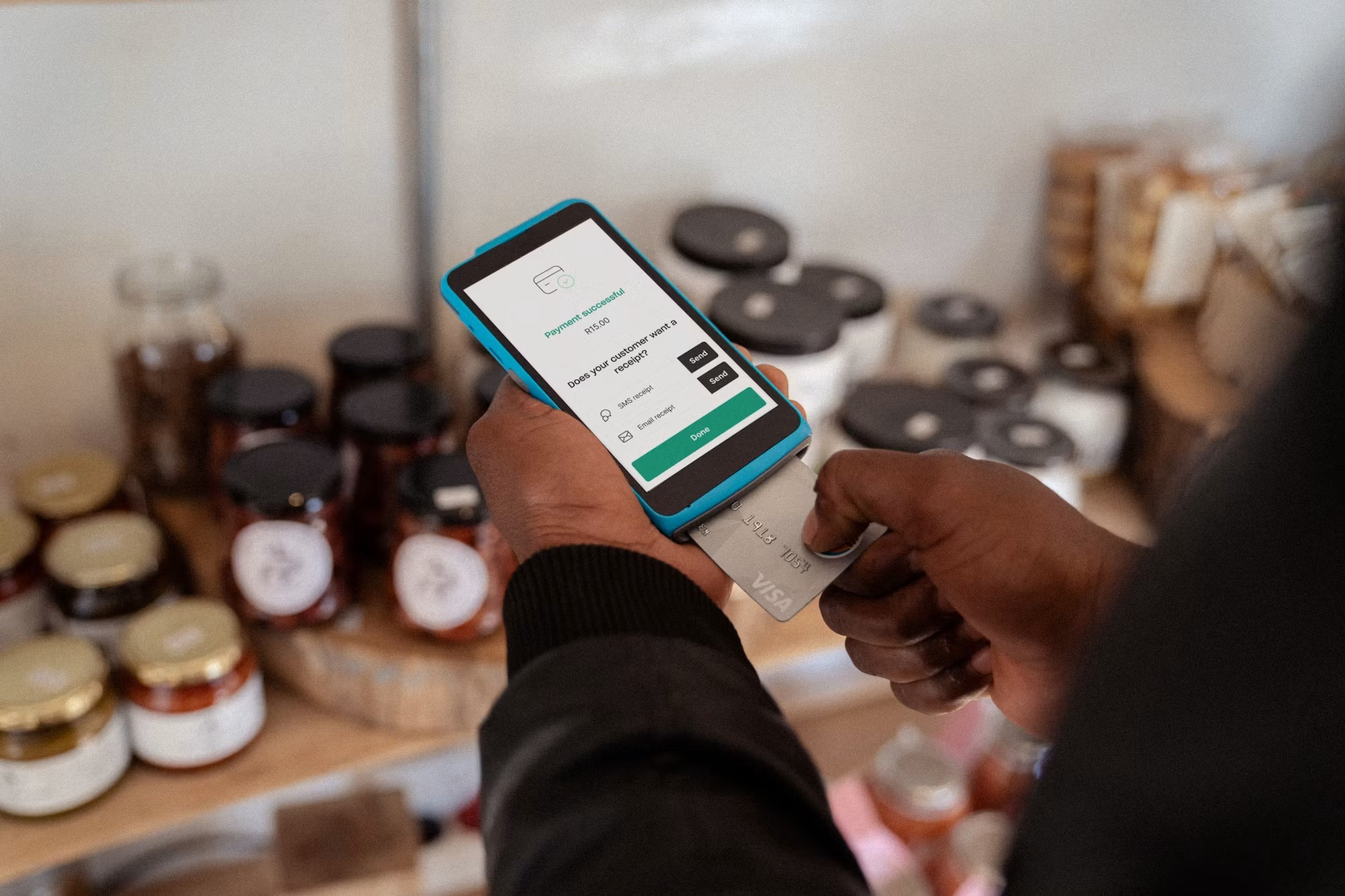
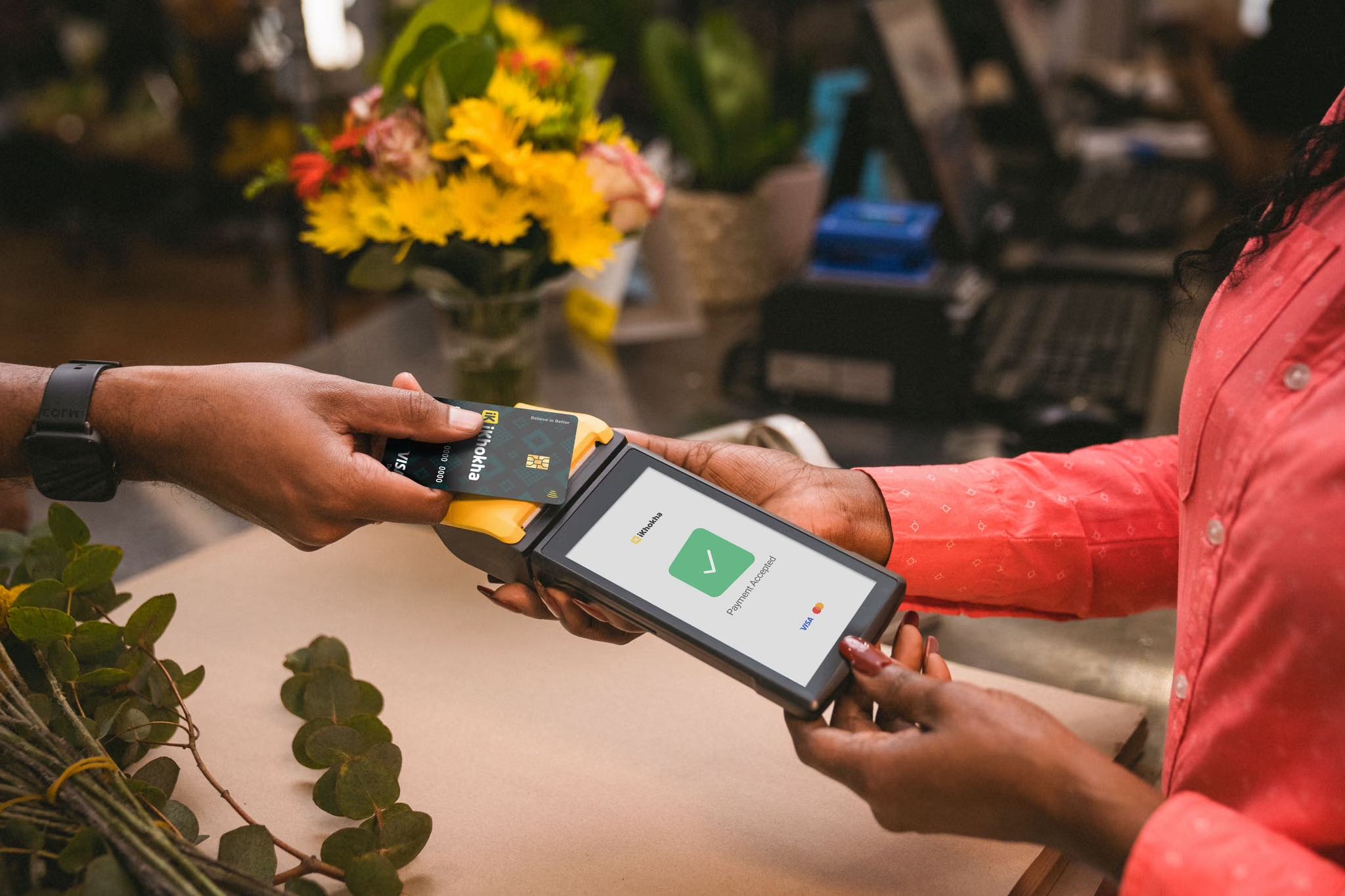
Commissioned · not yet shotThe two card machines I recommend here already solve the problems you are likely to face at a market stall. Both work on their own mobile data, so there is no Wi-Fi to find. Both are built to last a trading day on one charge: Yoco says 18 hours for the Khumo 2, and iKhokha says all day for the iK Flyer Lite. And both are small enough to hold in one hand, with no counter and no phone needed.
For a stall that is only open a few Saturdays a year, I have also included iKhokha's free Tap on Phone app, so you can find out whether cards are worth a machine before you buy one.
So this guide starts with five things a trading day demands, and measures each machine against them, so you have a clearer picture before buying.
What a stall actually needs
They are in the order a market day tests them.
Last the whole day on one charge
From setting up at six to packing up at four, with no plug and nowhere to leave a power bank safely.
This is the requirement that decides the article. A card machine that dies at two has cost you the busiest part of the day, and a trader cannot nip out to charge it.Find signal where the market actually is
A field, a parking lot, a church hall, a rank. One network has bars there and another does not, and it is not the same one every week.
A single-network machine is a machine that works at some markets. That is a worse problem than a slow one.Survive weather, dust and being dropped
Wind, an unexpected shower, dust off the ground, and a device handled with one hand while the other holds stock.
You cannot replace it on a Saturday. Whatever breaks, breaks for the rest of the day and probably the rest of the month.Handle a day that is half cash
Most stalls take more cash than card. The money you made needs to end up in one place without an evening of adding up.
If the card machine only knows about card, you still have two sets of books and no idea what the day actually made.Pay out before the next market
The money you made on Saturday needs to be available to buy Friday's stock.
Markets are weekly, so a settlement delay is not a day of waiting, it is a week of trading with less stock than you could have carried.What is deliberately not on that list is the transaction fee. A stall turning over R8 000 on a good Saturday pays about R184 in fees at 2.30% against R220 at 2.75%, and a R36 difference does not decide anything next to a machine that stops working at two.
If you want the fee arithmetic in full, our ranked field prices every machine over a year. For a stall it is the wrong axis.
How the three measure up
Same five, three machines, and where a company gives no figure, the grid says so.
| Requirement | Yoco Khumo 2, R699 | iKhokha iK Flyer Lite, R699 | iK Tap on Phone, free |
|---|---|---|---|
| Full day on one charge | 18 hours on one charge, stated by Yoco | All-day battery life, no figure given | Your phone's battery, and it is also your phone |
| Signal anywhere | Multi-network SIM, picks whichever works, data included | Dual SIM, unlimited data at R75 a month | Your phone's signal, one network |
| Weather and dust | Rated for spills, steam and dust; ATEX certified | Nothing said about dust or weather | It is a phone at an outdoor stall |
| Cash and card in one place | Yoco POS, free on Core | Records cash payments and tips alongside card | Same iKhokha app |
| Paid before next market | 1 to 2 business days, no settlement fee | 1 to 3 business days, R2.50 a payout | Same as the Flyer Lite |
← scroll the table sideways on a narrow screen →
Three notes on that grid.
"Nothing said" is not "does not work". The iK Flyer Lite may well shrug off a dusty Saturday. iKhokha simply does not make a claim about it, and Yoco does, so on a bar about weather the one that commits to something wins the row. If durability decides your purchase, that difference is the whole point; if it does not, ignore the row.
The same goes for battery. "All-day battery life" may be entirely true. It is just not a number you can hold anybody to, where 18 hours is.
And the R75 is not a trap, it is a price. It buys unlimited data on two networks, and iKhokha charges it because the data genuinely costs something. Yoco has decided to bundle that cost into the machine instead. Over a year it is R900, which matters at this end of the market, and it is the single clearest reason a stall and a spaza shop land on different machines.
The battery is the whole decision
Of the five, one is not a preference. Four of them cost you money at the margins; this one costs you the afternoon.
Yoco states 18 hours on one charge, a number it can be held to, and roughly double a full trading day with the setup and the pack-up on either end.
A trader who is watching a battery indicator is a trader who starts steering customers to cash at midday to make it last, and steering customers to cash is how you lose the ones who do not carry any. The point of the card machine was to stop turning people away, and a machine you are rationing has stopped doing its job.
If you sell at a market a few Saturdays a year rather than every week, none of this applies with the same force. Take the free option, keep your phone on a power bank, and spend nothing while you find out whether it is worth R699 to you.
The stall that should buy iKhokha
There is one, and it is common enough that it changes the answer rather than qualifying it.
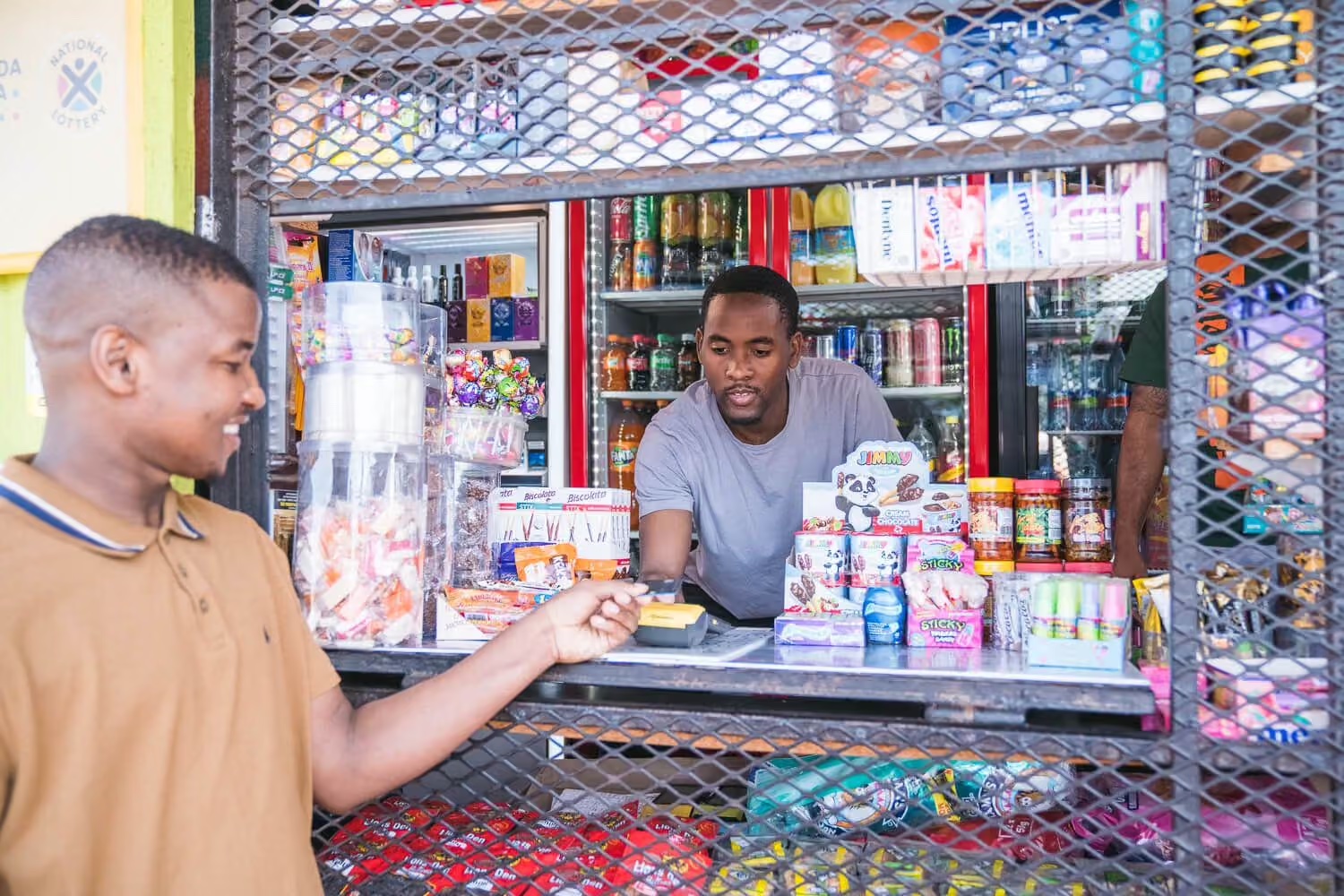
If your stall also sells airtime, data, electricity or vouchers, buy the iKhokha iK Flyer Lite. The card machine sells all of it and keeps a commission, and at a market that is not a side line: a person who stops for airtime is a person standing at your table looking at everything else on it.
Here is what that costs. iKhokha costs you R36 more on an R8 000 Saturday at 2.75% Excluding VATThe rate before 15% VAT is added, which is how almost every South African provider quotes. A rate of 2.30% excl. VAT actually bills you 2.645%, so two quotes are only comparable once you know which basis each is on.What a Saturday actually costs2.30% bills 2.645% with VAT on it. On an R8 000 Saturday that is R212 rather than R184, and the gap to iKhokha's 2.75% is about R36.Every card machine rate in South Africa is quoted excluding VAT, so the providers are directly comparable to each other with no conversion. Almost no market trader is VAT-registered, which means you do not claim it back and the inclusive number is your real cost. Add 15% to every rate here. It is also why the rate is the wrong axis for a stall: 15% of a small number is still a small number, and a machine that dies at two o'clock costs more than a year of rate difference.See every term in the glossary against Yoco's 2.30%, plus R75 a month for the data and R2.50 every time it pays you. Call it R160 a month for a weekly trader.
Clear R160 of prepaid commission and it has cost you nothing. On a stall where people are already asking, that is not a stretch. On a stall where nobody asks, you are paying R160 a month for a menu you never open, and the whole case collapses.
Count a month of requests you currently turn away before you decide. Our iKhokha review works the prepaid arithmetic out properly, and the spaza guide covers the fixed-counter version of the same trade-off.
Two things nobody tells a trader
Neither is about the machine, and both cost traders money every weekend.
Take the deposit for a custom order on the day it is agreed. Both companies give you a free payment link that works on your phone, with no hardware involved. A customer who commissions something at one market and collects at the next is a customer who sometimes does not come back, and you have already bought the materials. A link sent while they are standing there fixes it.
Record the cash on the same machine. iKhokha's Lite records cash payments alongside card, and Yoco's POS does the same on Core (Yoco's plan)Yoco's standard plan, and the one almost every small business is on. It costs R0 a month, charges 2.30% excluding VAT per local card sale, and includes the dual-SIM mobile data free for life. Instant Payout costs R17.25 for a payout of up to R1 000 and 1% above that, up to R10 000 a day.What a stall pays for itR0 a month, for as long as you have it. A winter of no markets bills you nothing, which is the difference between a plan and a subscription.Core is Yoco's free plan and the one almost every trader should be on. Every Yoco figure in this guide is quoted on it: 2.30% excluding VAT, no monthly fee, no settlement fee, and the multi-network data included for life. That last part is what matters at a stall, because it means there is no month in the off-season where the machine is costing you something for sitting in a box.See every term in the glossary. It sounds like admin and it is the opposite: at the end of a market you have one number instead of a card statement and a tin, which is what tells you whether the day was actually worth the table fee.
So what should a market trader buy
Buy the Yoco Khumo 2 at R699. It clears all five of this guide's requirements, and it is the only machine here that gives a figure for the two things that actually end a trading day early: 18 hours of battery, and a SIM that picks whichever network is working where you are standing.
The data is included for life too, so there is no month where the machine costs you anything at all.
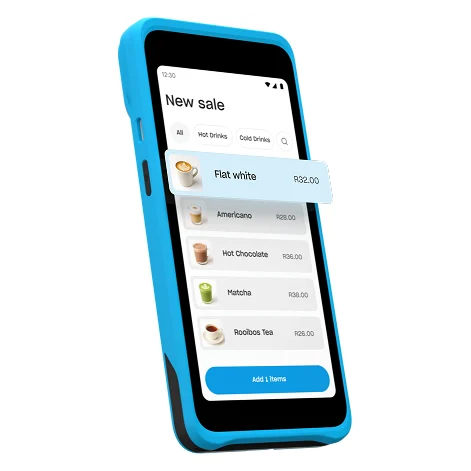
Yoco Khumo 2
18 hours of battery, a SIM that picks the network that is working, and the data included. R699, or R599 through our link.
Buy the iKhokha iK Flyer Lite at the same R699 if your table also sells airtime, electricity or vouchers. The commission clears the R75 data and the higher fee on a stall where people are already asking, and it brings people to the table who were not going to stop.
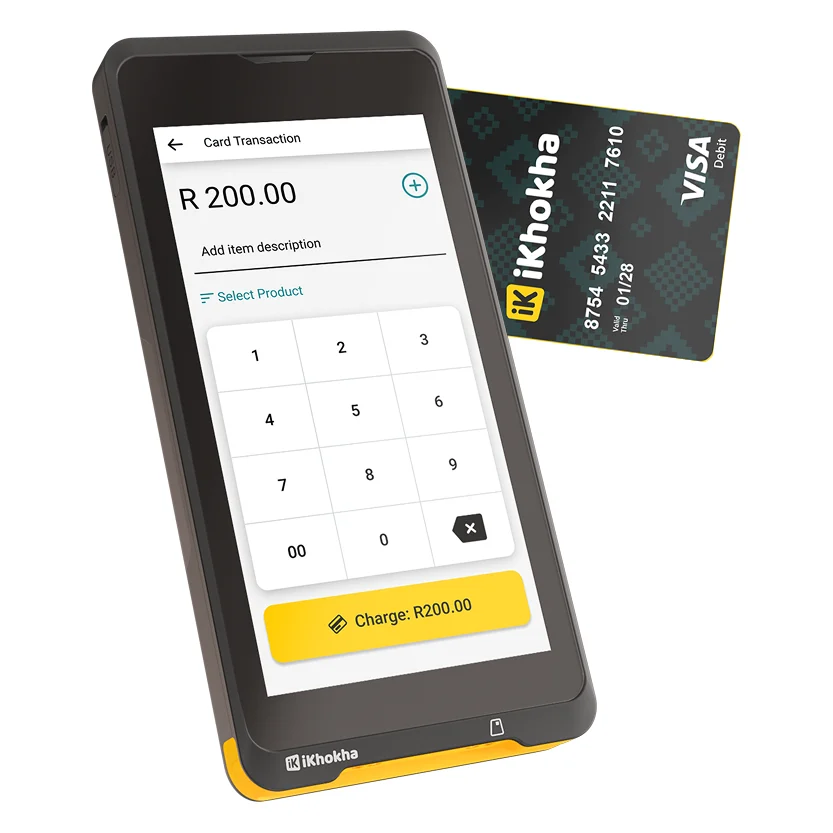
iKhokha iK Flyer Lite
Airtime, electricity and vouchers from the same machine. R699, about R629 through our link, plus R75 a month for the optional SIM.
Take iK Tap on Phone, free on Android or Huawei, if you only sell a handful of Saturdays a year. Your phone is the card machine and its battery is the limit, but it costs nothing to find out whether cards are worth a machine to you.
Whichever you pick, neither company locks you in. No contract, no monthly minimum, and the machine is yours once bought, so a stall that guesses wrong is out R699 rather than out of options.
Not sure which of the five requirements is the one that decides yours? Answer the three below for your own table.
Interactive · 30 seconds
Which one for your stall?
Answer for how your business actually runs, and the recommendation updates as you go.
1How often do you sell at a market?
2Does anyone at your table ask for airtime, data or vouchers?
3Is there power where you set up?
Before you answer

The Yoco Khumo 2, for a stall that is open most weekends
18 hours on one charge, a SIM that finds whichever network works, and unlimited data included, so nothing about the machine is monthly.
The trade-off: your table cannot earn on airtime, and getting your money early costs a percentage.
Specs, prices and rates come from each company's own website, checked 2 September 2026. We measure every machine against this article's five requirements, written from a trading day before any product page was opened, which is why iKhokha wins the row about cash and Yoco wins the row about weather.
Questions traders actually ask
Choosing
What is the best card machine for a market stall in South Africa?
The Yoco Khumo 2 at R699 once-off.Yoco states 18 hours of battery on one charge and uses a multi-network SIM that picks whichever network is working where you are standing, with unlimited data included at no extra cost. Those are the two things that end a market day early. The iKhokha iK Flyer Lite is the same R699 but charges R75 a month for its data. Checked 2 September 2026.
Practical
Do I need Wi-Fi for a card machine at a market?
No. Both the Yoco Khumo 2 and the iKhokha iK Flyer Lite have their own SIM cards and work on mobile data anywhere with cell coverage.Yoco includes unlimited data at no extra cost and uses a multi-network SIM, so it switches to whichever network is working at that market. iKhokha's dual SIM is a flat R75 a month for unlimited data, or free if you run the machine on your own Wi-Fi.
How long does a card machine battery last at a market?
Yoco states 18 hours on one charge for the Khumo 2, which is roughly double a full trading day with setup and pack-up included.iKhokha describes the iK Flyer Lite as having all-day battery life but gives no figure. For a trader with no power at the stall, a stated number is worth more than an adjective, because a card machine that dies at two costs you the busiest part of the day.
Costs
Is a card machine worth it for a market trader?
Usually yes, and the rate is not the reason.A stall taking R8 000 on a Saturday pays about R184 in fees at 2.30% excluding VAT, against R220 at 2.75%, so the difference between the cheapest and the most expensive machine is around R36. The value is in the customers who carry no cash, which at most South African markets is a growing share of them.
Can I take a deposit for a custom order at a market?
Yes, free, and without the machine.Both Yoco and iKhokha generate payment links you send from your phone, so a customer who commissions something at one market pays a deposit while standing at your table rather than at the next one. That matters for traders who buy materials up front for orders that are sometimes not collected.