Business guide
The Best Card Machine for a Salon in South Africa (2026)
A salon's money problem is the empty chair, not the card rate. What a salon needs from a card machine, against five requirements, and which machine clears them.

Some links here are referral links, and where a provider gives our readers a better price than its own site, that is the price you get by using one. It costs you nothing extra, and every option here is judged on the same test either way.
A salon's card machine is judged on the deposit it can take and the diary it sits next to, not on the rate alone.
Commissioned · not yet shotA salon does not lose money on the card fee. It loses money on the chair that sat empty from two until four because somebody did not arrive and did not phone.
That is why comparing salon card machines on transaction fees is close to useless. Twenty appointments a month at R350 is R7 000 of card turnover, and the difference between the cheapest fee in this market and the most expensive is about R45 a month. Your no-show rate is worth ten times that.
So for a salon, the question is not which machine is cheapest. It is which one does something about the parts of a salon that actually leak money, and based on my on-field research, there are five of those.

What a salon actually needs
Written from a salon's day rather than from anybody's product page. Every machine below is measured against these five, in this order, and nothing gets recommended for clearing a bar that is not on this list.
Take a deposit before they arrive
A link you can send on WhatsApp when the booking is made, so the client has money in the appointment before they decide whether to turn up.
This is the single biggest money leak in a salon. A R100 deposit on a R350 colour changes the arithmetic of not bothering, and it is the only thing on this list that pays for the machine in a month.Handle a tip without a conversation
The machine prompts for it at the end of the sale, the client picks an amount, and nobody has to ask out loud.
Tipping is normal in South African salons and awkward when it has to be raised. A prompt on the screen collects money that a cash-only counter mostly loses.Know which stylist earned what
Staff profiles on the machine, so each sale is attributed as it happens rather than reconstructed on a Sunday night.
If you have chair renters or commission stylists, this is your payroll. Doing it from a bank statement is an evening a week.Sell hair/nail products at the counter
Simple product and stock handling in the same app as the payments, so retail is not a second system.
Retail is the highest-margin thing a salon sells and the first thing that stops happening when it is admin.Not need Wi-Fi to work
The card machine has its own mobile data, so a load-shedding hour that takes the router does not take the till.
Salons run appointments through the day. An hour of not being able to take payment is an hour of clients you cannot release.Before we continue, notice what is not on that list. Transaction fees are not on it, because at salon volumes it does not decide anything. Neither is the printer: these days, almost nobody asks a hairdresser for a printed slip, and the ones who do will take it by email.
If a machine clears four of these five, the fifth is a preference. If it clears two, no fee in the world makes up for it. Our small-business guide runs the same test across six other types of business.
How the three machines measure up
Same five requirements, three machines a salon would realistically consider, and no scores invented to fill a grid.
| Requirement | Yoco Khumo 2, R699 | Yoco Counter, R2 999 | iKhokha iK Flyer Lite, R699 |
|---|---|---|---|
| Deposit before arrival | Payment links, free on every plan | Same payment links | iK Pay Link |
| Tip prompt | On the machine | On the Neo Touch | Not published as a feature on the machine |
| Stylist attribution | Staff profiles on the machine | Same staff profiles, bigger screen | Dashboard reporting rather than profiles on the machine |
| Retail at the counter | Yoco POS, free on Core | A countertop till rather than a handheld | The prepaid menu; a product list means the iK POS, from R660 a month |
| Works without Wi-Fi | Dual SIM, data included for life | A fixed counter setup, so plan power as well as data | Two SIMs at R75 a month, or your own Wi-Fi |
← scroll the table sideways on a narrow screen →
Only two brands are on that grid, and the reason is not the same for each of them.
Yoco is on it because it clears all five requirements on the cheapest machine it sells, and the deposit link that fixes the empty-chair problem costs nothing on any plan.
iKhokha is also on it because it clears four, and wins a fifth that the grid cannot show, which for some salons decides the whole question.
Its two partly marks are worth reading properly. The dashboard does report per-sale data, so you can work out who earned what; it is simply not attributed on the machine as the sale happens. And the R75 SIM is optional, so a salon on Wi-Fi pays nothing for it. Neither is a reason to walk away.
That fifth one is walk-in customers, and it is off the bar only because not every salon has them. iKhokha's card machine sells airtime, data and electricity for commission, and no Yoco machine does that at any price.
The deposit, which is the whole argument
Of the five, one of them is not like the others. Four are conveniences. This one is guaranteed money you are currently losing.
Both Yoco and iKhokha give you a payment link for free once you have signed up: you generate it, send it on WhatsApp with the booking confirmation, and the client pays a deposit before the day. No hardware is involved and it works on a phone you already have.
These two companies also give you a free payment gateway that you can add to your current salon website if you are already taking bookings online or planning to do so.
Run it once and the maths stops being arguable: at 2.30% Excluding VATThe rate before 15% VAT is added, which is how almost every South African provider quotes. A rate of 2.30% excl. VAT actually bills you 2.645%, so two quotes are only comparable once you know which basis each is on.What a salon actually pays2.30% bills 2.645% with VAT on it. On a R7 000 month that is R185 rather than R161, so the whole rate question for a small salon is about R24.Every card machine rate in South Africa is quoted excluding VAT, so the providers are directly comparable to each other with no conversion. Most single-chair and two-chair salons are not VAT-registered, which means you do not claim it back and the inclusive number is your real cost. Add 15% to every rate here. It is also why the rate is the wrong thing for a salon to optimise: 15% of a small number is still a small number, and one recovered no-show is worth more than a year of rate shopping.See every term in the glossary, R7 000 a month costs about R185 in card fees.
Two no-shows a month is R700 gone, which is nearly four times what the machine costs you to run. A R100 deposit does not recover all of it, but it recovers most of it, because the client who will not pay R100 to hold a slot was never going to arrive.
And that is the whole point for putting a card machine in a salon, and it has nothing to do with cards, but shows customers that you are always ready.
The thing you will be sold wrongly
Yoco does have a built-in appointment book, and it is good. It is also not on the free plan, and that is the thing a salon owner is most likely to be told incorrectly.
Appointment management sits on Plus (Yoco's plan)Yoco's middle plan at R249 a month per location. It is the tier that carries appointment management, a built-in loyalty programme and multi-location management, and it lowers the card rate to 2.10% excluding VAT on local debit up to R50,000 a month. Nothing on Core is taken away to make it; Plus adds. The plan above it is Pro at R499 a month, which is the only tier where fast payouts are free.What a salon is actually buyingR249 a month, and the only thing on it most salons want is the appointment book. Loyalty and multi-location come with it whether you use them or not.Yoco's middle plan, at R249 a month per location. It is the tier that carries appointment management, a built-in loyalty programme and multi-location management, and it lowers the local debit rate to 2.10% excluding VAT up to R50 000 a month. Nothing on Core is taken away to make it. The tier above is Pro at R499 a month, which is the only one where fast payouts are free. For a salon the question is never Core against Plus as products; it is whether the diary costs you more than R249 a month in chaos.See every term in the glossary at R249 a month. Everything you need to take a payment is on Yoco's Core plan and costs nothing, which is exactly why the diary is a separate decision rather than part of the machine.
If the diary is genuinely costing you more than R249 a month in double-bookings, forgotten slots and phone tag, move to Yoco's Plus plan and it pays for itself immediately. If you are a one-chair salon with a WhatsApp thread and a notebook that works, it will not, and nobody should sell it to you.
The machine is the purchase. The subscription is a later question, and answering it in that order is how you avoid paying R2 988 a year for a feature your notebook was already doing.
So if you are deciding on a card machine from Yoco, buy it on Yoco's Core plan, keep booking the way you book now, and watch it for a month. These are the three a salon chooses between, from the handheld most salons buy to the countertop till.
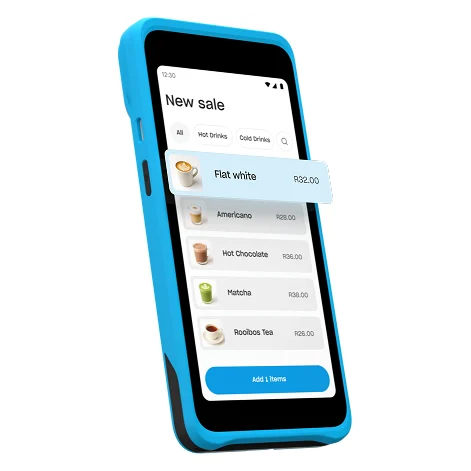
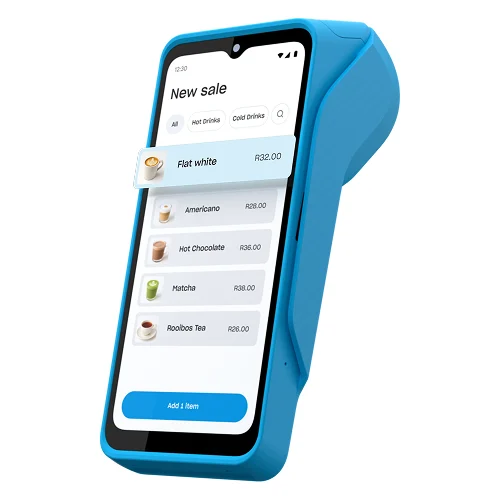
Yoco Khumo 2
A handheld you carry to the chair. Clears all five requirements on this page at the lowest price Yoco sells.
Yoco Khumo Print 2
The Khumo 2 with a printer, for a salon whose clients still expect a slip in the hand.

Yoco Counter
A countertop till with a Neo Touch card machine in the box, for three or four chairs and a retail shelf.
When the Counter is worth R2 999
The Khumo 2 is a handheld. For a lot of salons that is right: you carry it to the chair, the client pays where they are sitting, and it goes back on the shelf.
Once you have three or four chairs, staff who are not you, and a shelf of retail worth managing, the Yoco Counter at R2 999 (down from R4 999 since July) is a different proposition.
iKhokha sells a countertop system too, the iK POS, and it is a serious machine rather than a lesser one. It is built for stock-heavy retail and for kitchens, and it is priced as a subscription rather than as a purchase.
Here is how the two compare on the things a salon actually pays for.
The difference is the shape of the price more than the size of it. The Counter is bought once and the card machine is in the box. The iK POS is bought and then subscribed to, and iKhokha states plainly that it cannot take card payments, so a card machine stands beside it either way.
What the subscription buys is depth: three thousand products, supplier tracking, promotions, staff management and payroll, plus table layouts and ingredients for kitchens. That is a real product, and a salon is not the business it was priced for. A shelf of retail and a list of services does not need three thousand lines.
Both companies' own figures, for one till at one salon.
The two countertop systems
| Yoco Counter | iKhokha iK POS | |
|---|---|---|
| The machine | R2 999 once-off, down from R4 999 | R7 499 once-off, down from R9 999 |
| Monthly | R0 on Core | R660 excluding VAT, and it is required |
| Card machine included | Yes, a Neo Touch in the box | No. iKhokha states the iK POS cannot accept card payments |
| Year one, one till | R2 999, and nothing after it | R7 499 plus R7 920 excluding VAT in subscription, plus a card machine |
| Stock depth | Products, categories and stock in the free POS | Up to 3 000 retail products, with supplier tracking |
| Loyalty programme | On Plus, at R249 a month | Included in the R660 |
| Staff | Profiles, permissions and per-stylist attribution | Staff management and payroll calculation |
| Printer | Not on the Neo Touch | Built in |
| Built for | A counter that takes payment and sells some retail | Stock-heavy retail, cafes and restaurants |
Read off yoco.com/za/pricing and ikhokha.com/shop/point-of-sale/ik-pos on 10 September 2026. iKhokha's subscription is quoted excluding VAT.
iKhokha wins four of these rows and none of them is the one a salon buys on.
The Counter is cheaper and simpler. The iK POS is deeper, and the depth is aimed at a business with more to count than a salon has.
The test I would apply is staff rather than size. If you are the only person taking payments, a handheld is better and cheaper. If somebody else is running the front desk while you are at a chair, a fixed till is what stops the day falling apart, and R2 999 against a stylist's daily takings is not a large number.
A salon renting chairs to independent stylists is the strongest case of all, because each of them needs their sales attributed and none of them should be carrying your card machine around. The Yoco review covers the range and the software in full.
When a salon should buy iKhokha instead
If your salon sits on a busy street, in a taxi rank, or anywhere people pass rather than arrive by appointment, the walk-in traffic is worth more than the diary. The iKhokha iK Flyer Lite at R699 sells airtime, data, electricity, DStv payments and vouchers off the same card machine.
Nobody walks into a salon for airtime. They walk past it, see that they can get airtime, and come in, and while they are standing at your counter they are looking at your shelf and your price list.
That is a different business model from an appointment salon and it is a legitimate one. The trade-off is real: 2.75% instead of 2.30% excluding VAT, R2.50 on every payout, and you fund the prepaid float yourself before it earns anything. Our iKhokha review works out the turnover at which that stops mattering, and the head-to-head puts the two side by side.
So what should a salon buy
Buy the Yoco Khumo 2 at R699 on Core (Yoco's plan)Yoco's standard plan, and the one almost every small business is on. It costs R0 a month, charges 2.30% excluding VAT per local card sale, and includes the dual-SIM mobile data free for life. Instant Payout costs R17.25 for a payout of up to R1 000 and 1% above that, up to R10 000 a day.What a salon gets free on itR0 a month, 2.30% excluding VAT, the POS software, digital invoicing, payment links and Tap to Pay on iPhone. Not the appointment book, which is R249 a month on Plus.Core is Yoco's free plan and the one almost every small salon should be on. Nothing on it is billed monthly and the dual-SIM data is included for life. The distinction that matters in this type of business is what sits above it: Plus at R249 a month adds appointment management, loyalty and multi-location, and Pro at R499 adds free fast payouts and table-side ordering. A salon buying the machine is buying Core; the diary is a separate decision made a month later.See every term in the glossary. It clears all five of this guide's requirements, it costs nothing monthly, and the two things a salon actually needs from it, the deposit link and the tip prompt, are both free and working on day one.
Add the Plus plan at R249 a month only once the diary is demonstrably costing you more than that. Not before, and not because somebody at a signup desk told you appointments come with it.
Step up to the Yoco Counter at R2 999 when somebody other than you is running the front desk, or when you are renting chairs and every stylist's takings need attributing separately.
Buy the iKhokha iK Flyer Lite at R699 instead if your door gets walk-past traffic all day. The prepaid commission is worth more than the fee difference costs, and it is income an appointment book cannot generate.
And if none of that is you yet, take no money out at all: Yoco's Tap to Pay is free on an iPhone and iKhokha's iK Tap on Phone is free on Android or Huawei, which is enough to find out whether your clients will use a card before you spend R699 on the question.
If your salon sits between two of those, the three questions below are the three that decided every section above: who handles the money while you are at a chair, whether your clients arrive or walk past, and what the booking book is costing you now.
Interactive · 30 seconds
Which setup for your salon?
Answer for how your salon actually runs, and the recommendation updates as you go.
1Who takes the money while you are at a chair?
2Do people walk past your door all day, or arrive by appointment?
3How much is the booking book costing you right now?
Before you answer

The Yoco Khumo 2 on Core, for most salons
R699 once, nothing monthly, and the deposit link and tip prompt that fix a salon's two real leaks are both free.
The trade-off: the built-in appointment book is a R249 a month plan on top, and your counter cannot earn on airtime.
Plans, prices and rates come from each company's own website, checked 2 September 2026. We measure every machine against this article's five requirements, written from a salon's day before any product was looked at, which is why the appointment book costs Yoco a row rather than winning it one.
Questions salon owners actually ask
Choosing
What is the best card machine for a salon in South Africa?
The Yoco Khumo 2 at R699 once-off on the free Core plan.It prompts for tips, attributes sales to individual stylists on the machine, and takes deposits through free payment links, which is what actually costs a salon money. At salon volumes the transaction rate barely matters: on R7 000 a month the gap between the cheapest and the most expensive rate in this market is about R45. Checked 2 September 2026.
Bookings
Does Yoco include an appointment book?
Not on the free plan.Yoco's appointment management sits on the Plus plan at R249 a month, alongside loyalty and multi-location management. What is free on the Core plan is the Yoco POS software, digital invoicing, payment links, Tap to Pay on iPhone and payouts to any bank. Buy the machine on Core and add Plus only if the diary is costing you more than R249 a month. Checked 2 September 2026.
How do I take a deposit for a salon appointment?
Use a payment link.Both Yoco and iKhokha generate one free, with no hardware needed, and you send it on WhatsApp with the booking confirmation so the client pays a deposit before the day. For a salon doing twenty appointments a month at R350, two no-shows cost R700, which is roughly four times the monthly card fees, so a R100 deposit recovers more than the machine costs to run.
Staff
Can a card machine track which stylist made each sale?
Yes on the Yoco Khumo 2 and the Yoco Counter, which carry staff profiles on the machine so each sale is attributed as it happens.That matters for commission stylists and chair renters, because the alternative is reconstructing it from a bank statement. iKhokha reports per-sale data on its dashboard rather than attributing on the machine itself.
Costs
Is a card machine worth it for a small salon?
Yes, and usually not for the reason people expect.A one or two-chair salon turning over R7 000 a month on card pays about R185 in fees at 2.30% excluding VAT. The value is in the deposit link that reduces no-shows and the tip prompt that collects money a cash counter loses, both of which are free. The machine is R699 once with no monthly fee on Yoco's Core plan.